
Dental Implants — Fort Worth, TX
Your Permanent Smile Awaits

Did you know that the American Academy of Implant Dentistry estimates that 3 million people in the United States have dental implants, and that number is growing by 500,000 each year? Their longevity and ability to restore teeth from roots to crowns stand out as some of the most worthwhile reasons to invest. Contact our dental office if you’re interested in scheduling a consultation with Dr. Desai and our team. We’ll be happy to begin the process of helping you achieve your permanent smile with dental implants in Fort Worth!
Why Choose Care 32 Dental of Fort Worth for Dental Implants?
- Partnering with Local Dental Implant Specialists
- CBCT Scanner Used for Accurate Treatment Planning
- Flexible Financing Available
What Are Dental Implants?
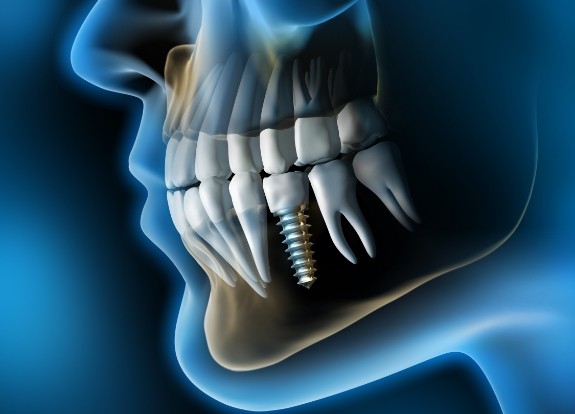
While dental bridges and dentures only rest on top of the gums, dental implants penetrate the gums and bone, fusing with surrounding tissues to establish a firm foundation for your new smile. Versatile in their ability to replace one or more missing teeth, you can receive a customized crown, bridge, or denture depending on the number of teeth you need to have replaced.
Dental implants are made of titanium and mimic the way natural tooth roots work. Delivering stimulation to the bone when chewing helps to reduce the potential for facial sagging, aging appearances, and further tooth loss.
The 4-Step Dental Implant Process
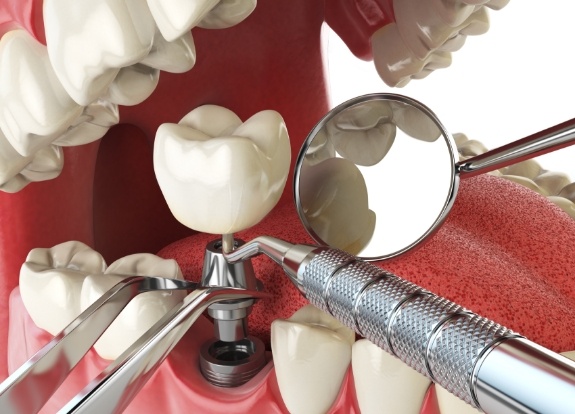
Although they all have the same goal, the process of getting dental implants is inherently different than that of temporary restorations like dental bridges and dentures. In fact, from start to finish, your entire dental implant treatment requires a multiple-step process that can span many months. While we certainly understand that you’re eager to get your new smile underway, this time is necessary for your dental implant success. At Care 32 Dental of Fort Worth, we proudly pair with local dental implant specialists who combine years of experience with the latest technology for a more comfortable, precise treatment. Although each patient’s path will look a little different, all must follow four important steps: the initial consultation, the surgery, the osseointegration period, and finally, the attachment of your prosthetic! Here’s a closer look at what happens during at each!
Initial Dental Implant Consultation
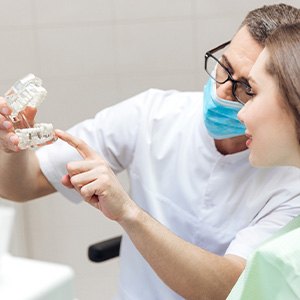
Your first step towards restoring your smile begins with your dental implant consultation at Care 32 Dental of Fort Worth. First, your dentist will examine your teeth, gums, jaw, and medical history to ensure you qualify for treatment. If you have any problems that could increase your chances of implant failure, we will need to correct those first. This may result in the need for preliminary procedures like gum disease therapy, bone grafting, or tooth extractions. Then, once your mouth is ready, we can continue planning the next steps of your dental implant treatment. At this time, we’ll discuss financial details, post op instructions, and how dental implants work in Fort Worth.
Dental Implant Surgery
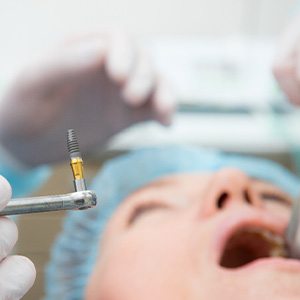
At Care 32 Dental of Fort Worth, we are pleased to partner with a trusted team of local specialists to perform your dental implant surgery. Your surgical team is not only extremely experienced, but they also use a technology known as guided dental implant surgery to provide the most accurate implant placement possible. This technology essentially gives your surgical team a blueprint for the exact location of where your implants will go, including their ideal angles and depths. Ultimately, this results in a more successful placement, lower risk of failure, and a faster and more comfortable recovery.
On the day of your procedure, you will arrive at the office and be taken to the surgical room. There, your mouth will be numbed, and once you’re comfortable, incisions will be made in the gums. Then, using the guided surgery map, the posts will be inserted into the jawbone, the incisions will be closed, and protective caps will be placed over the posts until your abutments are ready to be placed.
Dental Implant Osseointegration & Abutment Placement
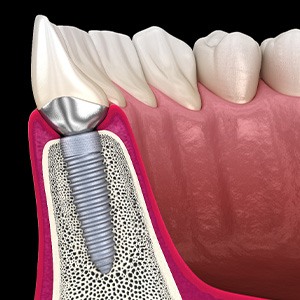
Osseointegration is the name of process where your dental implants permanently fuse with your jawbone. This step can take anywhere from four to nine months but is absolutely imperative for your dental implants’ success. Once your jaw has completed this step, you will be ready to have your abutments placed. These are the pieces that connect the dental implant post to the restoration (teeth). In some cases, you may be able to have the abutments placed when your implants are attached, however this will depend on the type of dental implant you’ll be getting and the discretion of your surgeon.
Abutment placement requires new incisions to be made in the gums, and will have a second, albeit smaller and milder recovery period, usually just a few weeks long. During this time, your new restorations will be custom crafted at the dental lab using the impressions taken during your dental implant consultation in step one!
Delivery of Dental Implant Restorations
The last step in your four-part dental implant journey is the placement of your restorations, in the form of either crowns (single teeth), a dental bridge (several teeth ‘stuck together’) or an implant denture (an entire arch of teeth). The exact restoration you select will depend on the number of teeth you’re replacing, and where along the arch they’ll be going.
Finally, once your restorations have been connected to the abutments, your dentist will exam your smile and make sure your bite looks and feels great before sending you off to use and enjoy your newly rebuilt smile!
Benefits of Dental Implants

If you’re looking for a tooth replacement solution that is cost-effective and lasts for decades, not years, dental implants are right for you. Designed with longevity in mind, these titanium posts are the foundational support for the custom-made restoration that will blend seamlessly with your smile. They’re also why you’ll be able to enjoy several benefits, such as the ones listed below. Keep reading to get a glimpse of what life will look like with dental implants in Fort Worth!
Day-to-Day Benefits

Dental implants are extremely easy to clean and maintain. Since they’re fixed in place and made from durable materials, you can brush, floss, and rinse like you would for natural teeth.
Osseointegration practically guarantees that your implants won’t slip out of place when you eat or speak. You’ll be able to smile with confidence, knowing that your restoration isn’t going anywhere.
Speaking of eating, dental implants will allow you to enjoy more foods. Because of their incredibly stable design, you’ll have the bite power you need to dig into steak, apples, carrots, and pretty much anything you want!
Health Benefits

Osseointegration enables another advantage: preserving your jawbone mass. Normally, your jawbone relies on dental roots for essential stimulation and circulation. Without these two things, it actually starts to deteriorate. To date, dental implants are the only restoration that can effectively replace your dental roots.
Leaving your smile gap empty can cause your natural teeth to shift. Often, the results of this are crooked pearly whites and the need for orthodontic treatment. With dental implants firmly rooted in place, though, your natural teeth will maintain their original positions.
Long-Term Benefits
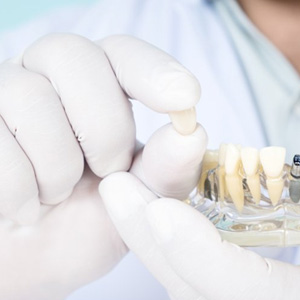
Studies show that even after 10 years from placement, dental implants have a 95% success rate. That means 95% of the time, they successfully support patients’ smiles without complication!
Preserving your jawbone doesn’t just help you avoid bone loss. It also helps maintain your facial structure, allowing you to look youthful and vibrant for many years to come.
With proper care, dental implants can last for 30 years or more! The incredible longevity of this restoration means you’ll spend less time and money on replacements, and that you’ll be able to enjoy all of their benefits for a long, long time.
Who Dental Implants Can Help

When faced with missing teeth, you might assume that traditional bridges or dentures are the only options for tooth replacement. But the reality is that you can enjoy dental implants just like many others! So, you shouldn’t hesitate to schedule a consultation with our team at Care 32 Dental of Fort Worth. You can also read on if you want to learn the qualities that we look for in a good candidate, as well as how we can replace one, a few, or an entire arch of missing teeth with dental implants.
Who Is a Good Candidate for Dental Implants?

In order to determine if you’re a good candidate for dental implants, our team needs to complete a comprehensive oral exam. In the process, we will review your dental history, take X-rays, and take a look at your gums to determine:
- If your jawbone can support dental implants
- If your gums are healthy and free of infection
- If you’re committed to taking good care of your smile
- If you’re willing to quit smoking and other harmful habits
Important reminder: If your jawbone has deteriorated or your gums are infected, that doesn’t mean that you’ll be stuck with an incomplete smile moving forward. Rather, it means that we will need to provide the necessary preliminary care. Then, once your mouth is ready to receive one or more titanium posts, we can proceed with the process of restoring the appearance of your smile and the strength of your bite.
Missing One Tooth
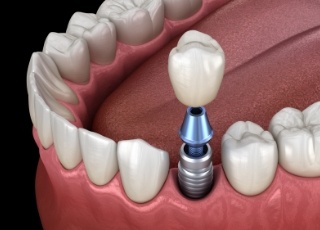
If you no longer want to find yourself among the other 120 million individuals who are living with a single missing tooth, then consider dental implants! If we determine that this is the best tooth-replacement solution for you, then we will place a single titanium post into your jawbone. Then, once the two have fused together, a dental crown will be secured on top with an abutment. Not only does this preserve more of your natural smile, but it also minimizes the risk of dental drift, which is a common occurrence among tooth-loss sufferers.
Missing Multiple Teeth
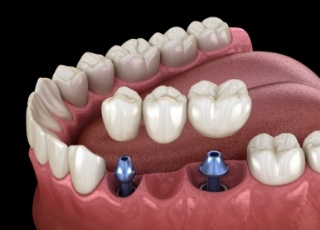
Previously, replacing three or four teeth consecutively required a fixed bridge. That’s no longer the case! With an implant bridge, we can equip you with two implant posts and a customized dental bridge that is secured to the top. Placed only in the exterior sockets, the titanium prosthetics will serve as a stable foundation for your new smile, allowing you to eat the foods you love and speak clearly without the unsightly gap.
Missing All Teeth
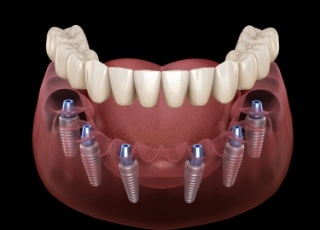
Implant dentures are a great way to replace an entire arch of missing teeth. Unlike a traditional prosthetic that relies on natural suction and denture adhesives, this unique alternative uses between four and six implant posts that are strategically placed along the arch to support a customized denture that is either fixed or removable when put into place.
There is also the option of All-On-4 implants. While traditional dental implants require enough jawbone density to support your custom-made restoration, All-On-4 uses only four titanium posts. Placed within the densest areas of the jawbone, they can support a fabricated denture and help you avoid needing a bone graft.
Understanding the Cost of Dental Implants

You want dental implants but you’re unsure if you can afford them. Their permanence and lifespan are what keep you intrigued and contemplating this kind of investment, but you worry that you simply won’t be able to cover the expenses required. The cost of dental implants is different for everyone, which is why you can count on our team to develop a treatment plan and cost estimate that works with your budget. Whether you choose to use dental insurance, we will find ways to maximize your benefits and help you save when it comes time to pay for your new smile.
Dental Implant FAQs
Does Getting Dental Implants Hurt?
To be honest, getting dental implants shouldn’t hurt. Dentists work to ensure the surgery is smooth and comfy.
You see, your mouth will be numbed before the procedure starts. The dentist will apply an anesthetic to ensure you don’t feel discomfort. Plus, you’ll likely be sedated as well. This latter measure will reduce your ability to register pain.
All that said, you may feel some post-surgery soreness. However, this effect is normal; it should fade after a few days. In the meantime, you can take prescribed pain medication as directed. If the discomfort worsens, though, don’t hesitate to call our office.
How Long Does It Take to Recover from Dental Implant Surgery?
It usually doesn’t take long to recover from implant surgery. If you’re like most, you can resume normal activities the day after placement. That said, avoid strenuous exercise for the first week after surgery; it would delay your recovery. Also, effects like bleeding or swelling will fade after a few days.
In contrast, fully healing from treatment involves more time. Implants often take up to six months to fuse with your jawbone. Before that period ends, you must be careful with your new teeth. The implants might fail early otherwise.
Can I Get Dental Implants If I Smoke?
Honestly, yes – it’s possible to get implants even if you smoke. Despite that fact, though, treatment isn’t a good idea for active smokers. Tobacco users have a higher rate of implant failure.
In reality, tobacco disrupts implant work. It often delays your recovery, increasing the risk of side effects. Also, it keeps implants from fusing well with your jawbone. Smoking can even give you a dry socket, dislodging the blood clot over the implant site.
Given these facts, smokers should take precautions before an implant treatment. The first is to give up tobacco products at least two weeks prior to implant surgery. Another is only to resume the habit 2-3 months after treatment.
Will People Be Able to Tell That I Have Dental Implants?
Except for dentists, people won’t notice that you have dental implants. The prosthetics will blend seamlessly with your other teeth.
To be clear, dentists personally design your implants. They take impressions before surgery so your new teeth have the right color, shape, and size. As such, the implants will match their surroundings well.
At the same time, remember that implants act like tooth roots. By fusing with your jaw, they remain secure and stable on their own. You won’t need to hold your jaw strangely to keep them in place.